
28 Sep Why We Use MCQs in J1 Physics, and How You Should Train for Structured Questions?
Why We Use MCQs in J1 Physics, and How You Should Train for Structured Questions?
Dear J1 Physics Students,
I would like to address something that a number of students have raised with us: Why does PMC spend so much of J1 working through MCQs? Shouldn’t we be doing more structured questions instead?
This is Mr Sim, CEO of The Physics Cafe. I thought it would be useful for me to explain personally why our curriculum is designed this way, because there is an important distinction between learning Physics and training yourself to write examination answers.
First, let me be clear
We do not use MCQs because we believe MCQs are more important than structured questions. They are not.
We use them because, particularly when introducing a new topic, MCQs allow us to teach the Physics in a deliberate and carefully designed sequence.
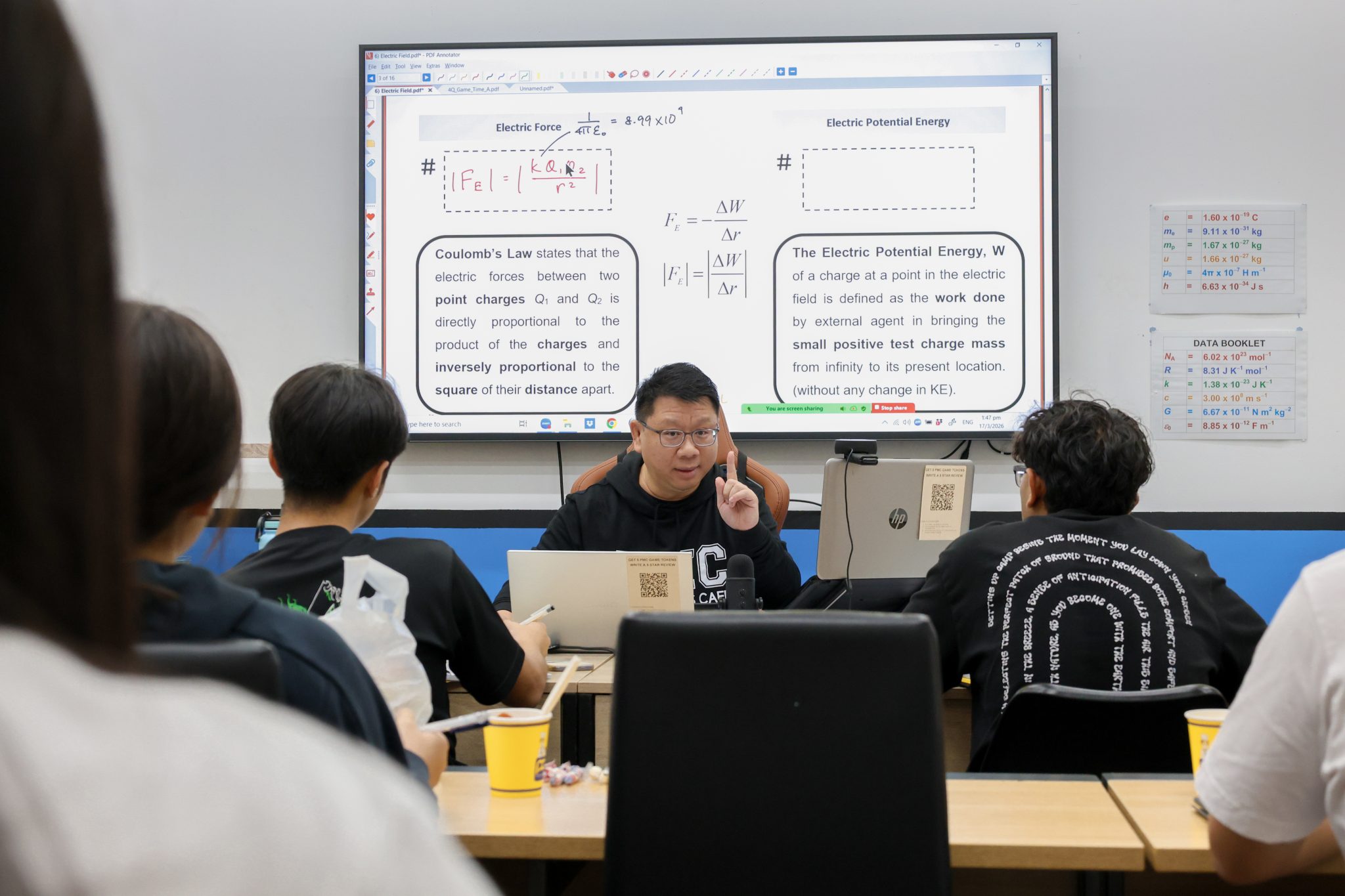
Think about how Physics is taught in school
You normally have lectures to learn the concepts, followed by tutorials where you apply those concepts to questions.
At PMC, we do not have separate lecture and tutorial periods every week. We therefore have to accomplish both within a much shorter amount of teaching time.
That is why our approach is already somewhat accelerated
Instead of giving you a long lecture first and questions afterwards, we teach much of the concept through the questions themselves.
Why not simply start a new chapter using structured questions?
Because structured questions are generally not written to teach an entire chapter from first principles.
A structured question may test one definition in Part A, a calculation in Part B, an explanation involving another concept in Part C, and perhaps a completely different application in Part D
That sequence is determined by the examination question. It is not necessarily the sequence in which the Physics should be taught.
When we design a PMC worksheet, however, we can deliberately choose the questions so that Concept 1 leads into Concept 2, which leads into Concept 3. We can introduce a misconception, challenge it, and then build the next idea upon the previous one.
MCQs are particularly effective for this because a good MCQ is not simply about choosing A, B, C or D.
The discussion around that question allows the teacher to explain why one answer is correct, why another very tempting answer is wrong, what misconception produced that wrong answer, and how the underlying principle should actually be applied.
That is how we use MCQs to teach Physics.

Then how do you become good at structured questions?
This is where I think there is sometimes a misunderstanding.
A student may perform poorly in structured questions and naturally conclude:
“I am not good at structured questions because I have not done enough structured questions during tuition.”
That conclusion is not necessarily correct.
Once you understand the Physics, structured-question performance depends heavily on whether you can translate that understanding into exactly what the examiner wants to see.
- You may understand the idea but omit one marking point.
- You may give a correct explanation but not use sufficiently precise Physics terminology.
- You may write three sentences when the mark scheme requires two very specific statements.
These skills improve through practice, but a large part of that practice must come from you actually attempting the answer yourself.
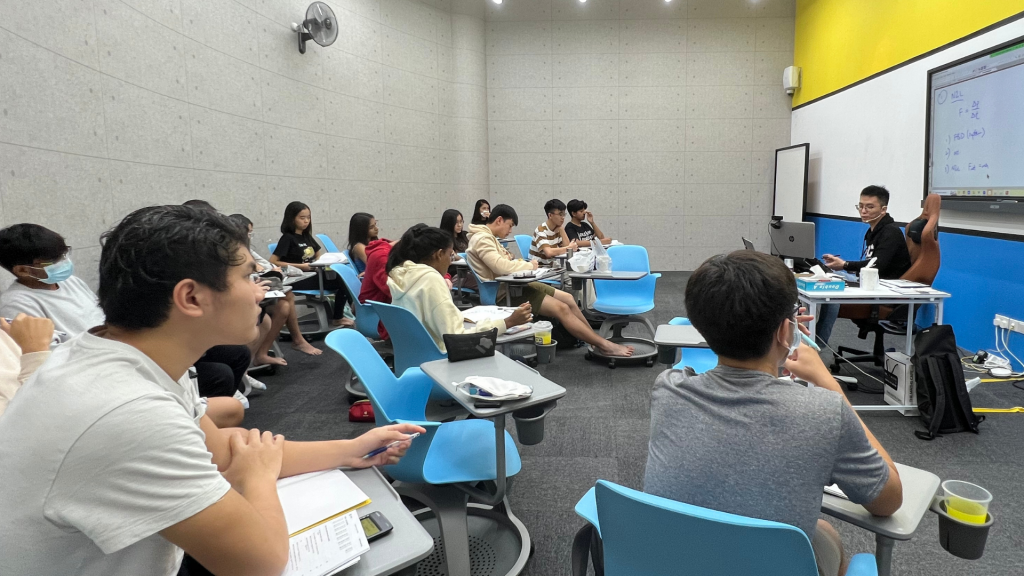
Watching a teacher write the perfect answer on the board is useful, but it is not the same as having to formulate that answer yourself
The training process should therefore look something like this:
Learn and understand the concept properly through the PMC lesson.
Attempt structured questions independently afterwards.
Write your answer before looking at the solution.
Compare your answer carefully against our worked solution or marking points.
Ask yourself, “What did the examiner require that I did not give?”
Adjust your wording and try again in subsequent questions.
That process of attempt, compare, correct and repeat is what gradually trains you to think like the examiner.
Some students acquire this very quickly. Others take considerably longer. That is normal.
But you cannot completely outsource this part of the learning process to the teacher. At some point, you must be the person holding the pen and deciding what to write.
Why do we increase structured-question work later?
There is also a reason for the timing.
During J1, a major objective is to build a strong conceptual foundation across a very large syllabus.
As you progress and the major examinations approach, the emphasis naturally shifts increasingly towards examination application, structured questions, answering technique and full-paper practice.

In other words, the sequence is intentional:
Understand the Physics first. Then become increasingly precise at expressing that Physics in examination form.
Trying to reverse that sequence can sometimes produce students who become familiar with particular question formats without developing sufficient flexibility when the examiner asks the same Physics in a different way.
What about schools that teach topics in a different order?
This is another genuine issue.
Different JCs do not always teach the syllabus in the same sequence. PMC therefore cannot follow every school’s timetable simultaneously.
We have to adopt one coherent curriculum sequence that allows the Physics itself to be taught properly across the year.
There will consequently be periods where your school is ahead of PMC in a particular topic, or where PMC has covered something your school has not yet reached. We provide lesson recordings and supporting materials to reduce this mismatch, but I recognise that it can sometimes be frustrating. That is a limitation of any common tuition curriculum serving students from different schools, rather than something we are unaware of.

One final point
I am sharing this not because I want you simply to accept our method.
I want you to understand the reasoning behind it.
If you feel weak in structured questions, absolutely practise more structured questions. You should.
But do not make the mistake of believing that the solution is simply for your tuition teacher to spend more classroom time going through structured questions for you.
A significant part of becoming good at structured Physics is learning to sit with a question, commit your own answer to paper, discover exactly where your answer differs from the examiner’s, and slowly close that gap.
That part cannot be done entirely for you.
Our responsibility is to teach you the Physics properly and give you the tools, questions, explanations and solutions to improve.
Your responsibility is to use them.
If both are done properly, the structured-question marks should follow.
All the best for the remainder of J1.
Mr Dave Sim
CEO
The Physics Cafe





Sorry, the comment form is closed at this time.